The Clock vs. The Care: Why Rushed Minutes Are Failing Our Most Vulnerable
The clock says: move on.
The person in front of you says: please stay.
That is the collision at the heart of home care across Brampton, Caledon, and the GTA.
When personal support is reduced to a list of tasks completed against a timer, something important gets lost. Not just conversation. Not just comfort.
Dignity.
Human connection.
The chance to notice what a checklist cannot.
The client behind the task
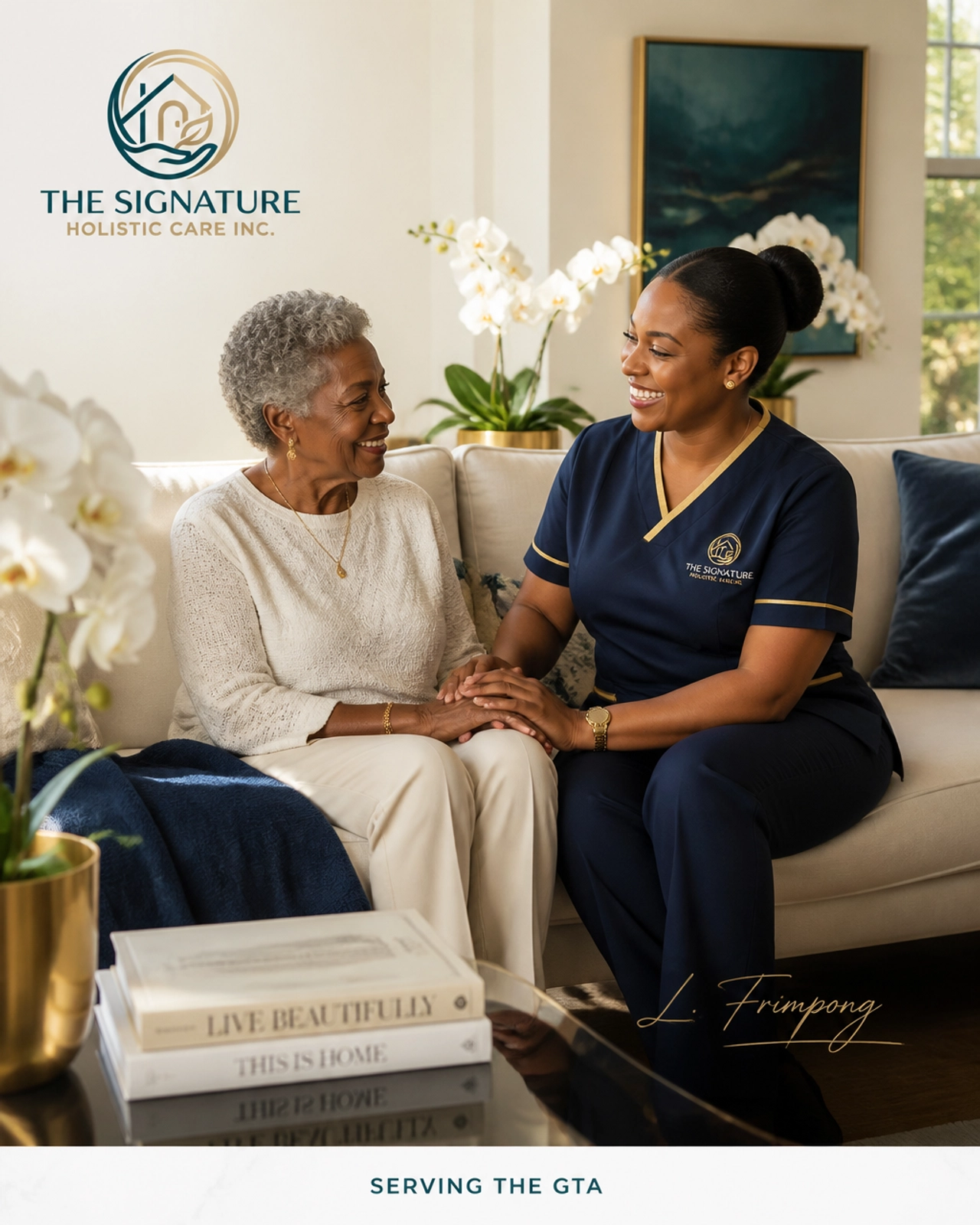
Letysha Frimpong, founder of The Signature Holistic Care Inc., once cared for a woman living with an extreme health condition.
Her needs were deeply personal. They included changing, wiping, and care around her catheter site, always within the appropriate care plan and scope of support.
Those tasks mattered.
But they were not the whole story.
The client also needed someone to talk to. Someone who would not treat her like a body to be managed or a room to be cleared before the next appointment.
So Letysha stayed.
They talked.
She offered emotional support. She rubbed the woman’s feet while they spoke. She built trust through the quiet moments that cannot be measured neatly in a scheduling app.
Often, Letysha went over her allotted time.
Not because the clock did not matter.
Because the person mattered more.
“Your client most likely does not want you there: they NEED you.”
That is the golden rule for caregivers.
It changes everything.
Before and after: what the clock could not see
Before
The client’s care was being delivered within a tightly loaded schedule. The required physical tasks were clear. The emotional need was not as easy to document.
There was pressure to finish and move to the next visit.
But the client needed more than personal care. She needed reassurance, company, conversation, and the comfort of being treated as a whole person.
After
The essential care still happened.
But so did the human care.
She was listened to. Comforted. Seen.
The foot rub was not a luxury add-on. The conversation was not wasted time. Those moments helped create peace inside a situation shaped by illness, dependence, and vulnerability.
This is a real client story from Letysha’s caregiving experience. The client’s name and identifying details are being protected.
And the lesson is uncomfortable:
The right care should not depend on a caregiver quietly donating time to make up for a broken schedule.
A checklist can record care. It cannot always deliver it.
A checklist can tell you whether a task was completed.
It may record:
- Personal hygiene assistance
- Continence care
- Mobility support
- Meal preparation
- Medication reminders
- Catheter-site support within the care plan
- Basic household assistance
All of these are important.
But the checklist may not capture that the client was frightened that morning.
It may not record that she had been alone for hours.
It may not show that she wanted to talk about her family, her pain, her memories, or the fear she was carrying.
It may not reveal the subtle change in her mood or energy.
This is why person-centred care requires more than task completion. It requires presence.
According to NICE guidance on the length of home care visits, visits should be long enough to meet a person’s identified outcomes without compromising dignity, wellbeing, or safety. The guidance is written for the UK, not Ontario, and it is not an Ontario legal requirement. But the principle is universal:
Care takes the time it takes.
Rushed care creates a hidden cost
When visits are too short, caregivers are forced to make impossible choices.
Do they:
- Finish the hygiene routine?
- Prepare food?
- Help the client move safely?
- Listen to what is worrying them?
- Look for changes in their condition?
- Stay long enough for the person to feel settled?
The most visible task usually wins.
The emotional need gets pushed aside.
Over time, that creates a dangerous gap between the care a person technically receives and the care they actually need.
A person may be clean but lonely.
Fed but frightened.
Changed but unheard.
Safe for the moment but emotionally abandoned.
That is not a criticism of caregivers. Many PSWs are doing everything possible inside systems that give them too little time, too many clients, and no room for the unexpected.
It is a criticism of a model that confuses efficiency with excellence.
The caregiver feels the pressure too
Letysha’s experience reflects a reality many personal support workers know well.
The schedule is full. The route is tight. The next client is waiting. The agency has assigned a specific amount of time, even when the person’s needs do not fit inside it.
So the caregiver carries the moral pressure.
They know what the client needs.
They know the visit should not end yet.
They also know that staying longer may put the rest of the day behind.
That is how burnout begins: not only from physical work, but from repeatedly knowing what good care looks like and being unable to provide it within the structure you have been given.
The solution cannot be to expect caregivers to sacrifice themselves indefinitely.
The solution is better assessment. Clearer communication. More thoughtful care planning. Continuity. Flexibility. And a service model that recognizes emotional support as part of care: not an optional extra.

What holistic care sees differently
Holistic care asks a larger set of questions:
Who is this person?
What helps them feel safe?
What makes them feel known?
What has changed since the last visit?
What does dignity look like for them today?
That may mean listening to favourite stories.
It may mean talking through a difficult morning.
It may mean helping someone feel less alone while completing necessary personal care.
It may mean noticing that a client is unusually quiet, confused, withdrawn, or fatigued: and reporting that change appropriately.
The clinical and the emotional are not competing priorities.
They work together.
A client who trusts their caregiver may communicate more openly. A person who feels respected may be less distressed during intimate care. A family may have greater peace of mind when they know their loved one is not being rushed through the day.
That is the difference between a visit and a relationship.
The Signature approach: clinical precision with a human heart
At The Signature Holistic Care Inc., Holistic PSW Care is built around both layers of support:
Clinical integrity
Care partners provide support according to the client’s care plan, professional scope, safety requirements, and documented needs.
Human connection
Care also reflects the person’s preferences, routines, favourite music, stories, comfort rituals, and emotional wellbeing.
Our Holistic PSW Care service supports seniors, people recovering from injury or illness, individuals with developmental support needs, and new mothers across Brampton, Caledon, and the wider GTA.
The goal is not to replace proper clinical protocols with kindness.
The goal is to bring kindness into the clinical protocol.
The science behind the service
The “science” is not only equipment or paperwork.
It is also consistency.
It is understanding that rushed care can increase distress. That familiar caregivers can build trust. That documented handoffs reduce the need for families to repeat the same information. That a client’s emotional state can affect how safely and comfortably care is delivered.
That is why the Signature standard includes care documentation, protected communication, continuity, and a living understanding of the person: not just a list of tasks.
Even in our second active service line, Signature Restoration, the same philosophy applies. Whether we are restoring a home with clinical-grade H13 HEPA filtration and 300° steam or supporting an individual through personal care, the tools serve the same mission:
Comprehensive restoration and compassionate care for homes and individuals across all life stages.
The equipment matters.
The process matters.
But the person comes first.
A Subscription to Peace
Families do not want to wonder whether their loved one was rushed.
They do not want to worry that a caregiver had to choose between finishing the task and offering comfort.
They want to know that someone reliable will arrive, pay attention, follow the plan, and recognize the human being behind the need.
That is what a true Subscription to Peace means.
Not perfection.
Not endless unpaid hours.
A dependable care relationship built on clinical responsibility, thoughtful planning, and genuine compassion.
For families in Brampton, Caledon, and the GTA, that peace can begin with a Signature Care Assessment.
No pressure.
Just a conversation about what support is needed, what matters most, and how care can feel more dignified from the very beginning.
Because care should never be measured only by how quickly someone leaves.
It should be measured by how safe, respected, and supported the person feels after they arrive.
Care That Feels Like Family.
